How Smartphone Batteries Work and Why They Degrade
Modern smartphones use lithium-ion batteries, which store energy through the movement of lithium ions between the anode and cathode materials during charging and discharging cycles. Each charge-discharge cycle causes microscopic structural changes in these materials — the repeated expansion and contraction as lithium ions move in and out creates mechanical stress that gradually reduces the number of lithium ions that can be stored and moved, reducing the battery’s capacity. This degradation is cumulative and irreversible — the lithium-ion battery that has been through five hundred charge cycles will hold less charge than it did when new, regardless of how carefully it has been used.
The battery health metric that most usefully reveals a battery’s current condition: the maximum capacity, expressed as a percentage of the battery’s original design capacity. The iPhone’s battery health feature (accessible in Settings > Battery > Battery Health) shows this percentage directly; Android’s equivalent information is available through third-party apps or manufacturer-specific diagnostic tools. The battery at 100% health holds its full original capacity; the one at 80% holds only 80% of the original capacity, explaining why it runs out significantly faster than when new. Apple recommends battery replacement when health falls below 80%, which they define as the end of the battery’s designed lifespan for the purpose of battery performance management.
Charging Habits That Extend Battery Life
The charging behaviour that most significantly reduces battery degradation rate: avoiding charging to 100% and discharging to 0% as regular practice. Lithium-ion batteries experience the most stress at the extremes of their state of charge — the final 20% of charging from 80% to 100% and the last 20% of discharging from 20% to 0% accelerate degradation significantly compared to cycling between 20% and 80%. The user who keeps their phone between 30% and 80% most of the time and only charges fully when they specifically need maximum range will see their battery health decline more slowly than the user who charges to 100% every night and runs the phone to 0% every day.
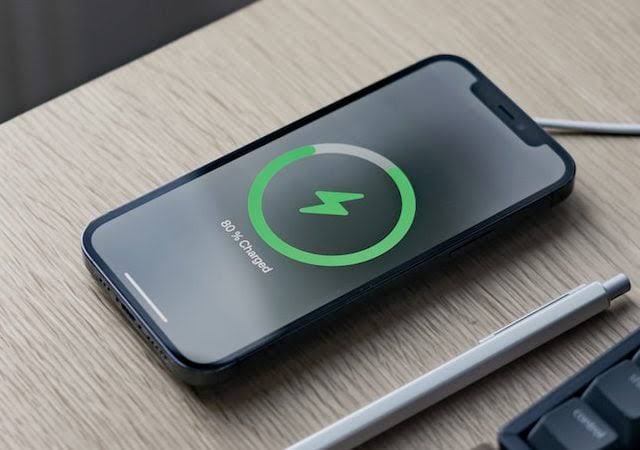
The charging practice that most damages battery health and is also extremely common: leaving the phone on a charger after it reaches 100% for extended periods. The lithium-ion battery held at 100% state of charge experiences the degradation stress of the high-charge state continuously — the phone that sits on a charger all night at 100% from midnight to 7 AM is experiencing seven hours of high-charge stress every day. Modern phones and chargers include optimised charging features (Apple’s Optimised Battery Charging, Android’s Adaptive Charging) that address this by learning the user’s charging schedule and delaying the final charge to 100% until shortly before the user is expected to unplug — a significant health improvement for users who regularly charge overnight.
Fast Charging and Wireless Charging: Convenience vs Health
The fast charging speed increase that has been one of the most aggressively marketed smartphone features: the progression from 5W standard charging to 15W, 30W, 65W, and in some manufacturers’ flagship devices, 100W or higher. The higher charging power that enables these faster rates also generates more heat during charging — and heat is the primary environmental factor that accelerates lithium-ion battery degradation beyond the normal cycle-based degradation. The phone that charges from 0% to 100% in twenty minutes at 100W is generating substantially more heat than the one that takes ninety minutes at 20W, and the accumulated heat exposure across thousands of charging sessions has a meaningful impact on battery longevity.
The wireless charging comparison to wired charging that most accurately characterises their relative battery health implications: wireless charging (inductive charging through the Qi or MagSafe standard) is less efficient than wired charging — approximately 80% efficiency versus 95% or higher for wired — and the energy that does not transfer to the battery is dissipated as heat in both the charging pad and the phone. The phone charged wirelessly accumulates more heat exposure per charge cycle than the phone charged with a standard wired charger. Whether this additional heat exposure causes meaningfully faster degradation than wired charging depends on the ambient temperature, the phone’s thermal management, and the time spent on the charger — but the efficiency and heat generation comparison suggests that wired charging is preferable for battery longevity when convenience does not require wireless.
When to Replace Your Smartphone Battery
The practical indicators that most clearly signal battery replacement is warranted rather than a new phone purchase: the battery health percentage below 80% combined with the experience of the phone not lasting a full day on a charge with normal use (the battery health percentage alone is not sufficient — a phone at 78% health that still comfortably lasts the day does not urgently require replacement, while a phone at 82% that barely makes it to mid-afternoon does), unexpected shutdowns at percentages well above 0% (which indicate that the battery’s maximum voltage output has degraded below what the phone requires under peak load, even if capacity is adequate for light use), and the degraded performance mode that Apple and some Android manufacturers implement to prevent shutdown by throttling CPU and GPU performance (which is the performance experience that most motivates battery replacement among users who notice it).
The battery replacement economics that most determine whether replacing a battery or replacing the phone is the better decision: the cost and availability of the replacement battery, the phone’s age and remaining useful life, and the improvement in experience that a new battery would provide versus a new phone. The two-year-old flagship with excellent performance except for battery life is an excellent battery replacement candidate — the replacement restores the phone to near-new battery condition for a fraction of the cost of a new phone. The four-year-old phone whose performance is adequate but whose software support has ended is a less compelling replacement candidate — the new battery extends the life of a phone that will not receive security updates, which creates a security risk that the battery replacement does not address.
Which Smartphones Have the Best Battery Life
The smartphone battery life evaluation approach that most accurately reflects real-world experience: the multi-scenario benchmark that measures battery drain across a range of usage types — continuous video streaming, web browsing over LTE, gaming, and mixed use — rather than a single-scenario test whose results may not reflect the specific usage pattern of the person considering the purchase. The phone that excels in the continuous video test but drains rapidly during gaming or navigation is not a good battery life phone for a user whose primary battery-intensive use is gaming.
The smartphone characteristic that most consistently predicts excellent real-world battery life: the combination of a larger battery capacity (measured in mAh — a 5000 mAh battery has the potential to last significantly longer than a 3000 mAh battery) with efficient processor and software optimisation. The phone with the largest battery does not always achieve the best battery life because the processor’s power consumption and the software’s efficiency vary significantly across manufacturers and generations. The Apple iPhone’s consistently excellent battery life results despite moderate battery capacities (by Android flagship standards) reflects the efficiency of the Apple Silicon chip and the tight integration between hardware and software that allows iOS to manage power consumption more precisely than Android’s more diverse hardware environment allows.